
The Yidam

By Michael Erlewine
In Vajrayana Buddhism, the yidam is considered the route of accomplishment or siddhi, providing the blessings and methods or actual path for spiritual realization.
The yidam is essential to understand in Vajrayana dharma, and is not as many believe, any kind of secret. It’s not secret, but rather unique to each individual and thus not applicable to anyone else.
The best I can offer is to share my own personal experience and give a critique of how yidams are often described. This highlights a common tension between conventional explanations and the lived reality of practice. I am not saying this is the only way, just that it is my experience.
Many standard accounts inadvertently externalize the yidam, framing it as something “out there” to be selected or invoked, like picking a deity from a catalog (e.g., Vajrayogini or Chakrasamvara). Of course, for starters, I did that many decades ago. For fun, here is my story.
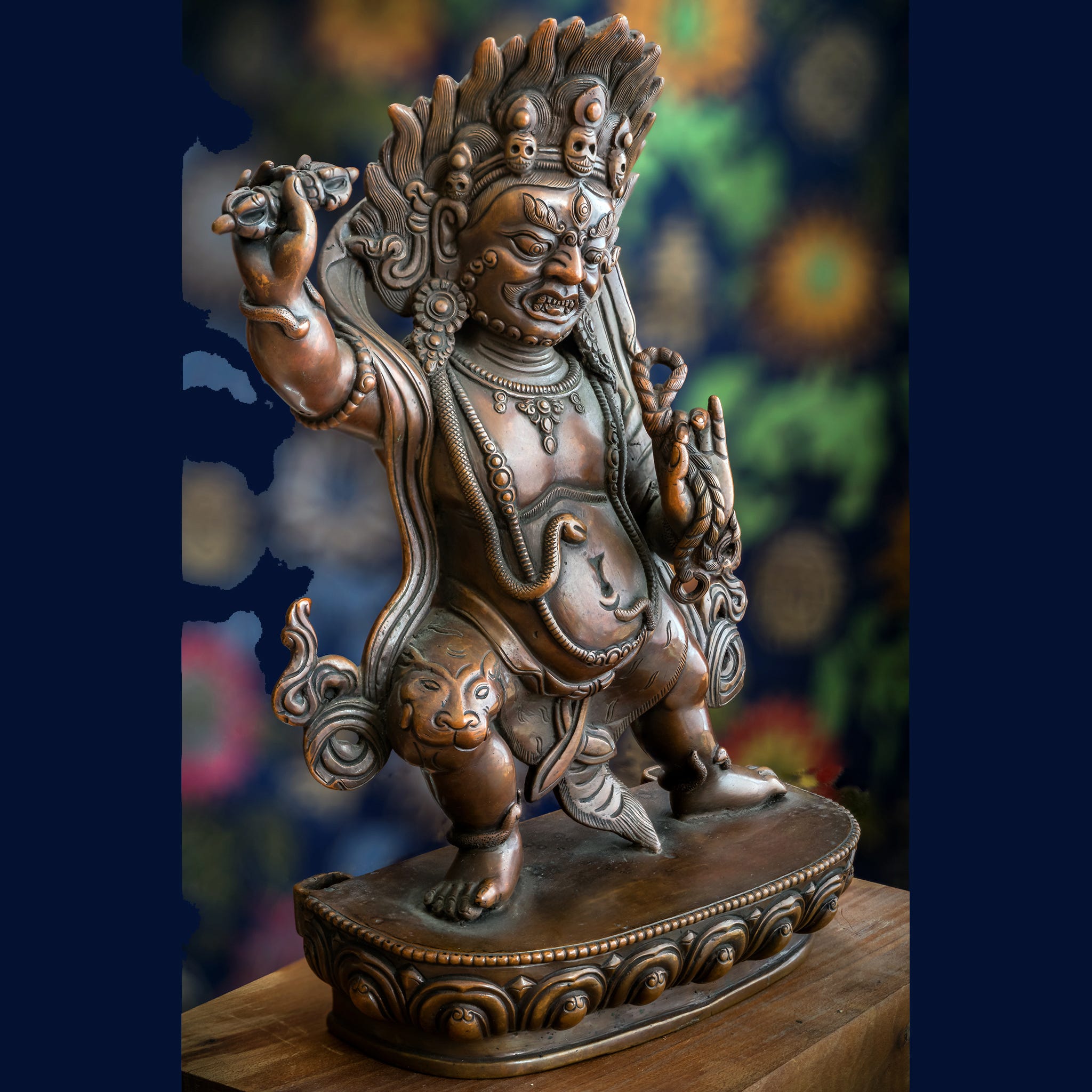
I decided and picked the Bodhisattva Vajrapani as my Yidam. I got all serious about it and asked my teacher, the Ven. Khenpo Karthar Rinpoche where I could get the empowerment. Rinpoche had not ever offered that empowerment, at least in this country.
Yet, kind that he is, Rinpoche agreed to come to our center (Heart Center KTC) and offer that empowerment, which to my surprise he did. I was so grateful. Along with the Vajrapani empowerment, rinpoche also gave instructions. The empowerment was from a cycle of empowerments by the 9th Karmapa, in this case “Dorje Tumpo,” a wrathful form of Vajrapani that had a 12-syllable mantra.
When one takes empowerment that we are very serious about it is customary to do 100,000 mantras for each syllable in that mantra, which I promptly did, some 1,200,000 mantras and with that I dug in.
Rinpoche took note and we made a special pecha (Tibetan style practice book) for Vajrapani. Kheno Rinpoche even had me come to KTD our monastery (Karma Triyana Dharmachakra) and instruct our Sangha in the Vajrapani practice, and in the main shrine room.
And to top that off I went, with my wife, and young son to Ralang Monastery in Sikkim where one of the four Heart Sons of the Karmapa lived, Goshir Gyaltsab Rinpoche, said to be the emanation of Vajrapani in the Karma Kagyu Lineage.
Gyaltsab Rinpoche gave the empowerment to me, my wife, son, and our dear friend Ngodup Burkhar who had been the translator for Khenpo Karthar Rinpoche for twelve years. And so that is my experience in picking a yidam from outside.
I did this practice for years, but over time I came to understand that no matter how much I loved and revered Vajrapani, and I still do, something was still missing. Khenpo Rinpoche and I had a good laugh about this when I was ready to admit that I still had a ways to go as to find for me a true yidam. I did my best, but no go. So much for my picking one out of a hat.
What followed was many more years of practice until more to do with fate than fancy, I actually found a natural yidam that led me to at long last Recognition, recognizing the true nature of my mind. There is no room here for that story, but I will tell it if there is some request for it.
Anyway, picking a yidam from the outside, at least for me, got everything backward. To me this can indeed feel like putting the cart before the horse, especially if it overlooks the organic, step-by-step discovery process where the true path emerges retrospectively through what actually works for us in our direct experience, i.e. we discover it from within.
In the Karma Kagyu lineage and broader Vajrayana traditions, our perspective aligns closely with deeper teachings on the yidam as an inherently internal process of realization, rather than an external object of focus. It comes from within and not from out there. We don’t take it in but turn what is within us into a path toward realization.
In other words, the yidam is not fundamentally an external deity to worship or “choose” in a preconceived way but rather an expression of our own enlightened nature, our buddha-nature or clear-light mind that unfolds for us through actual practice. It’s a method for transforming ordinary self-perception into enlightened awareness, discovered experientially by us rather than being imposed or selected from the outside.
Yidam’ is an Internal Expression of Our Own Nature
At its core, in Vajrayana dharma (including the Karma Kagyu), the yidam represents the inseparability of pure awareness and form, emanating from our own innate potential rather than existing as an independent, external entity. It is discovered or revealed to us through our own internal practice.
Traditional texts and teachers emphasize that the yidam should not be regarded as an “external god who will save us,” but as manifestations of our true, enlightened essence finally revealed. This “godless” or naturalistic approach avoids supernaturalism, instead treating our yidam as a tool for internal self-transformation, much like relating to a mythical or fictional figure for inspiration, without literal belief in their external reality. Yidams are a means, not an end in themselves.
For instance, yidams aren’t limited to divine forms; they can be historical humans (like Machig Labdrön or even the Karmapa in Karma Kagyu), living people, or even us visualized as enlightened, as long as we can confidently merge our mind and become one with that enlightened quality.
This internal framing addresses the concern that the yidam isn’t something we “know” upfront by naming an external deity, but a dynamic bond that reveals itself through the actual practice of purifying the mind, leading to the realization of emptiness and the true nature of reality.
In deity yoga (the heart of yidam practice), we don’t just focus on something outside; we visualize and become the yidam because it is our path, gradually replacing our ordinary mind and self-image with our more enlightened faculties as we discover them. This process activates our inherent potential for qualities like wisdom or compassion, transforming disturbing emotions into constructive energy without relying on an external savior. We do this ourselves!
The analogy of arriving somewhere and then looking back to describe how we got there captures the essence of yidam practice as a “lightning path” or swift method in Vajrayana, simply meaning it finally works because we work it. Our path is revealed as we go.
It’s not about predetermining the route by selecting a deity in advance but instead allowing within us a workable path to emerge through guided experimentation and continuing direct experience. All natural.
This can begin with a teacher’s empowerment (wang), which plants a seed by introducing a yidam form suited to our karmic inclinations or obstacles—not as a fixed external choice, but as a starting point for us to explore. Often contemplation of the ‘Common Preliminaries (The Four Thoughts That Turn the Mind Toward the Dharma) is again required to jump start our learning the practice of Mahamudra.
In Karma Kagyu specifically, this internal discovery is amplified by the lineage’s emphasis on guru yoga, where the lama (often the Karmapa) or our guru serves as the source of the yidam, embodying the path itself. The yidam emerges as a “heart bond” through our actual practice, not intellectual selection, aligning with our view that it’s about finding what actually works for us experientially.
As mentioned, a view that is misleading deals with externalizing the yidam from outside, and introductory teachings or cultural adaptations, where yidams are presented as deities to make them more accessible, yet to me that has it just backward.
Advanced Vajrayana instructions clarify that at best this is provisiona. Yidams have no inherent existence and are inseparable from our own mind, which we must discover each for ourselves. Our Yidam is that path that ultimately will work to bring us to realization or at least Recognition.
Choosing a fixed form like Vajrayogini isn’t the end goal but only a provisional scaffold—much like if we had a map we adjust as we travel. It’s our way to go.
The real “workable path” we describe arises through trial, refinement, and realization, where the yidam reveals itself as our own nature, not something imposed or taken in from outside.
This avoids the cart-before-horse trap by prioritizing direct experience over conceptual labeling.
[A rupa of Vajrapani that is on my shrine.]
For a limited time, I am doing a few Zoom astrology readings. If interested, please email me with the subject “READINGS.”
EMAIL Michael@Erlewine.net Note: If you would like to have access to other free books, articles, and videos on these topics, here are the links:
Free books: SpiritGrooves.net.
Free Videos: YouTube.com/channel/UC3cL8v4fkupc9lRtugPkkWQ
MAIN BLOG: https://www.facebook.com/MichaelErlewine

https://medium.com/@MichaelErlewine/
http://michaelerlewine.com
As Bodhicitta is so precious,
May those without it now create it,
May those who have it not destroy it,
And may it ever grow and flourish.
typo’s corrected:
Michael, I’ve been reading some ofyour posts for the past month or so, and I noticed that your writing and sharing has become less winding, more focused, with greater clarity about your own path, with implications for the path of many dharma practitioners. this kind of writing becomes a dharma practice. Your phrase — retrospective awareness — looking back on the long and winding journey toward realization… is an apt characterization for a dawning awareness. much thx for your insightful sharing. Sarva mangalam 🙏
Michael, I’ve been reading some ofyour posts for the past month or so, and I noticed that your writing and sharing has become less winding, more focused, with greater clarity about your own path, with implications for the past of many dharma practitioners. this kind of writing calms a dharma practice. Your phrase — retrospective awareness — looking back on the long and winding journey toward realization… is an apt characterization for a dawning awareness. much thx for your insightful sharing. Sarva mangalam 🙏