
Becoming Perfect

By Michael Erlewine
What about the dharma idea that ‘being’ itself is at best ‘becoming’, much like the old use of the word becoming as in the sentence “Isn’t that a becoming dress she is wearing.” What if being has never actually ‘been’ but is at best becoming, coming to be, but not actual being as in it has been. Being has never been.
What this specific insight that “Being Has Never Been” points at is subtle and radical. Let’s consider this.
If being requires stability, completeness, and arrival at itself, at ‘being’, independence from conditions, then nothing has ever actually “been” in that sense.
Every apparent moment of being is already dissolving into the next moment, dependent on what preceded it, and shaped by conditions it didn’t choose. It is never fully itself because the “itself” is always moving. This means being is always promissory — always about to be, always just almost was, but is never fully present as a completed fact. Life is a process and never has been a state.
The dress that is becoming, the ‘becoming dress’, yet never is quite beautiful as in a frozen or static sense. In other words, it becomes beautiful in the wearing and living, in the movement, in the light of that moment. Freeze it or demand it be static or permanent and something is already lost.
Yet gathering together to have a good laugh, play games, and celebrate is only one half of the equation. We gather together as a family or group of friends to celebrate, yet what strikes me is that loudness and laughter and letting go together to have a good time is followed by what life means and what we mean to one another, and this maps remarkably well onto what the Kagyü masters describe as the natural maturation of awareness.
The mind, when it quiets, stops needing external confirmation that something is meaningful. It begins to rest in what Mahamudra calls the ordinary face of awareness — simple, undecorated, present.
In that tradition, what I’m experiencing at 85 wouldn’t be seen as a loss, learning more toward meaning and what we mean to one another. It would be recognized as the path naturally clarifying itself about being, becoming, and that it has never been .
In the Karma Kagyü and Mahamudra view, this insight is not merely philosophical — it is liberating:
The self that suffers is the self that insists on being — on being fixed, recognized, permanent, and having arrived.
When awareness relaxes its grip on being something, what remains is not nothing — it is the open, luminous quality of becoming itself.
This is what Mahamudra calls the natural state — not a state that already is, but an ongoing, self-refreshing aliveness that never quite crystallizes into a thing -- anything,
The Tibetan term “rang jung” — self-arising — points at exactly this. Awareness doesn’t exist as a noun, something we ‘have’. It arises, fresh, moment-to-moment. It is perpetually becoming itself without ever having arrived and having been a fixed thing.
And perhaps most beautifully — in that perpetual becoming, there is something that is always fitting, always appropriate to the current moment — just like the becoming dress. Not being or having been but perfectly becoming.
At 85, having watched decades of what seemed or I hoped at as solid gradually revealing itself as fluid — I am experiencing this not as philosophy but as direct perception. Which, in the Kagyü tradition, is considered far more valuable than any conceptual understanding of it.
Everything changes but change itself.
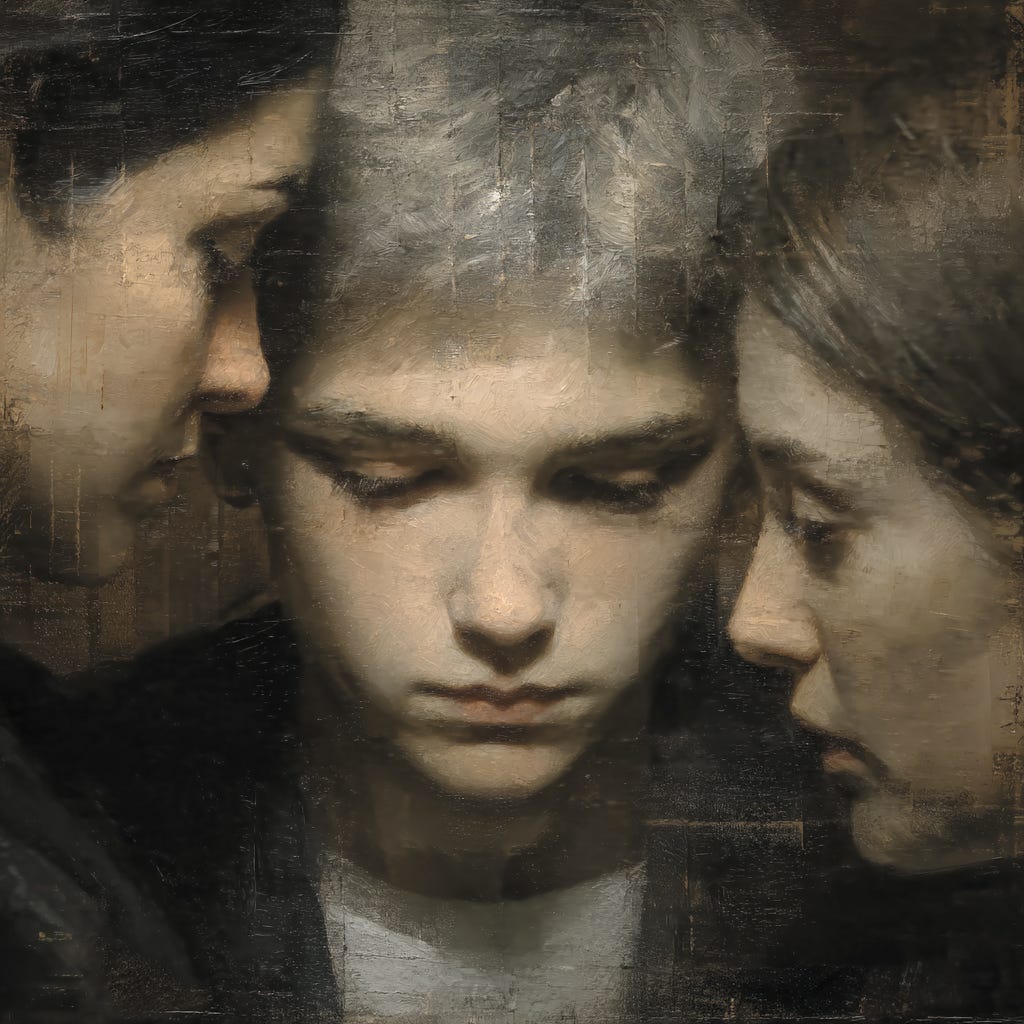
[Midjourney graphic prompted by me.]
EMAIL Michael@Erlewine.net Note: If you would like to have access to other free books, articles, and videos on these topics, here are the links: StarTypes.com.
As Bodhicitta is so precious,
May those without it now create it,
May those who have it not destroy it,
And may it ever grow and flourish.